Navigating the unpredictable environments of emergency medical services requires a diverse toolkit tailored to rapidly shifting scenarios.
Incorporating the aluminum penlight alongside the tactical flashlight into a standard uniform setup ensures that responders never have to compromise between patient comfort and scene safety.
Failing to carry both distinct tools can lead to critical delays when transitioning from a chaotic outdoor environment into the back of an ambulance.
Equipping oneself with a dedicated diagnostic instrument alongside a rugged field light allows for seamless adaptability from the moment a call begins.
Why One Light Isn't Enough in the Field
A high-intensity beam designed to cut through nighttime darkness will inadvertently blind a patient during a neurological assessment, causing severe discomfort and inaccurate diagnostic readings.
Conversely, a soft, targeted light built for close-up medical examinations fails entirely when clearing a dark hallway or securing an active roadway.
To maintain both patient safety and situational control, professionals must split their reliance between two specialized lighting categories.
How MedTechKits Empowers Field Clinicians
Recognizing these compounding field challenges, MedTechKits dedicates its mission to designing specialized gear that complements every standard medkit carried in the back of an ambulance.
By focusing on the exact tactile and operational needs of modern first responders, the brand connects raw utility with clinical sophistication.
This targeted support ensures that professionals can face stressful shift realities without encountering equipment failure or functional limitations.
The Clinical Standard: MedTech Aluminum Penlight
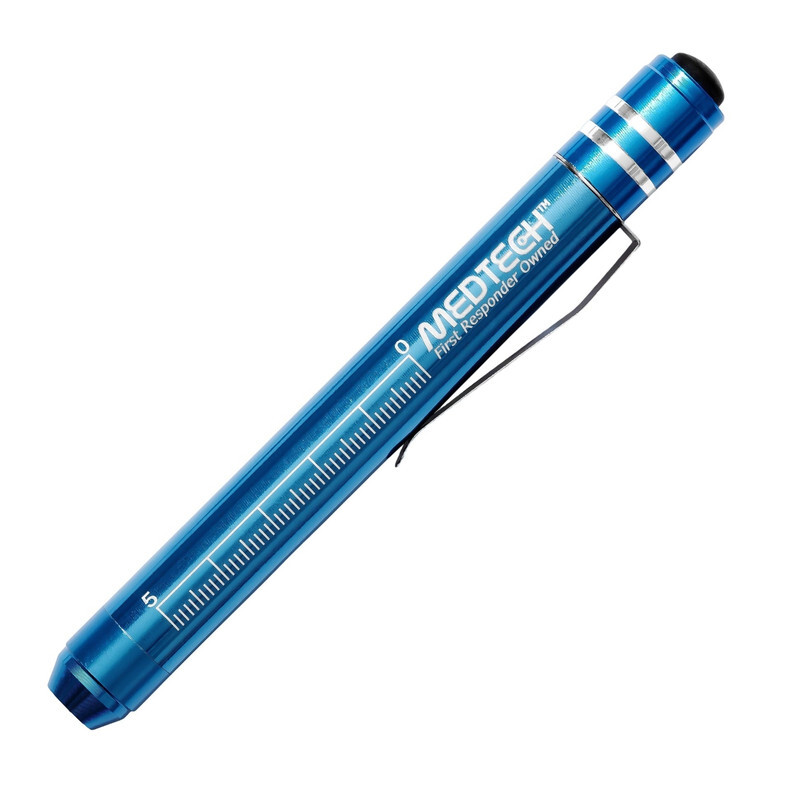
When the focus shifts from managing the broader environment to evaluating an individual patient, a highly refined and precise tool takes precedence.
The MedTech aluminum pen light medical tool from MedTechKits embodies this clinical focus, serving as a dedicated instrument for close-quarters physical examinations.
Engineered specifically for the rigorous demands of medical triage, this device provides the controlled, subtle light beam necessary for delicate diagnostic work.
Its lightweight yet robust profile allows it to rest comfortably in a breast pocket, always within arm's reach during initial patient contact.
IP67 Protection & Built-In Reference Scales
Constructed from heavy-duty aluminum casing, this penlight is built to withstand the messy realities of fluid exposure and demanding clinical rotations.
The inclusion of an IP67 certification guarantees total dustproof defense and reliable waterproof performance, allowing it to be thoroughly sanitized between patient contacts.
Beyond its physical durability, the penlight functions as a rapid cognitive aid during critical moments of patient evaluation.
The side of the chassis features laser-engraved pupil gauge scales alongside a 5 cm measuring ruler to facilitate immediate, objective assessments.
Why Diagnostic Lighting Matters for Patient Assessment
The core utility of this clinical tool rests in its engineered soft white LED light, which balances visibility with patient comfort.
Standard consumer flashlights emit harsh, piercing beams that trigger involuntary squinting and distorted pupillary responses during neurological checks.
Accurate pupillary assessments serve as a crucial window into a patient’s neurological status, revealing potential traumatic brain injuries or chemical impairments.
Having a dedicated tool that yields clear, uncompromised physiological feedback ensures that baseline data is captured correctly on the first attempt.
The Scene Safety Powerhouse: MedTech Tactical Flashlight
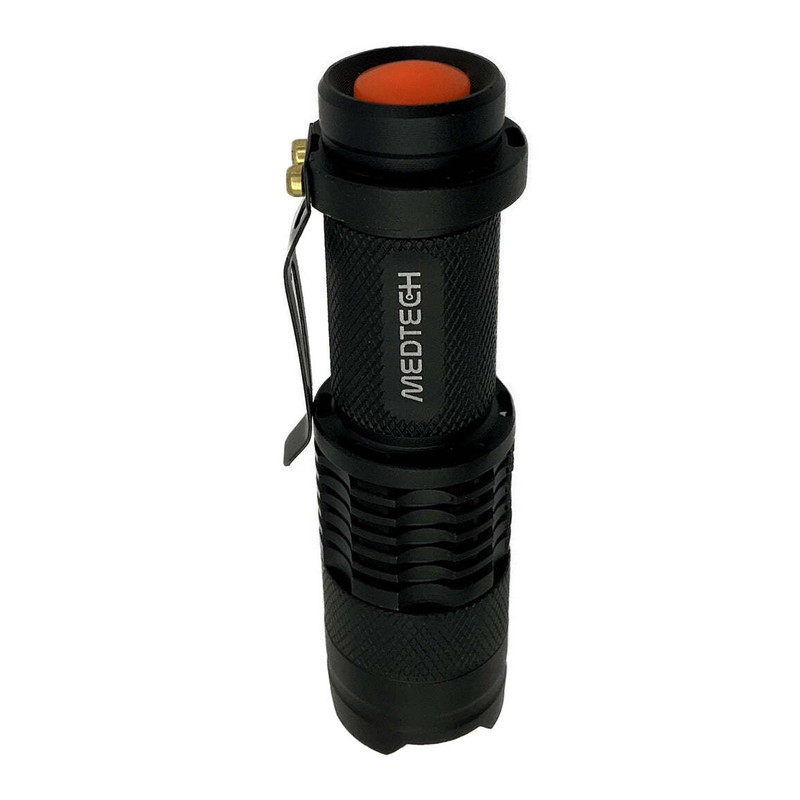
As operations move outside the controlled space of the ambulance cabin or clinical bay, the demand for stronger light beam becomes paramount.
The MedTech tactical flashlights step into this role, offering a rugged build designed to command authority over dark, hazardous surroundings.
The tactical flashlight shifts the operational focus from individual diagnostic evaluation to comprehensive environmental control.
Whether managing a vehicle accident on an unlit highway or searching a pitch-black alleyway, first responders require a commanding visual presence to mitigate risks.
Its robust architecture ensures that the team remains safe while performing duties in inherently unstable conditions.
350 Lumens & 3-Mode Versatility
Equipped with a powerful 350-lumen output, this tactical flashlight effortlessly slices through heavy fog, driving rain, and absolute midnight darkness.
The internal circuitry provides three distinct operational modes, allowing users to cycle between high-beam dominance, low-beam efficiency, and a high-frequency strobe setting.
The high-beam mode maximizes visibility during expansive search operations, while the low-beam alternative preserves battery longevity during prolonged standby periods.
Meanwhile, the specialized strobe function serves as a critical signaling mechanism to alert oncoming traffic or gain attention in high-stress tactical environments.
Built for the Elements: Telescoping Zoom & Heavy-Duty Clip
The structural engineering of this tactical tool prioritizes mechanical adaptability through a smooth, telescoping zoom mechanism.
With a simple slide of the flashlight head, the user can seamlessly transition from a broad, wide-angle floodlight to a tightly focused spotlight.
Complementing this versatility is a highly resilient chassis featuring an easy-grip texture that prevents slippage during wet or stormy weather.
A integrated, heavy-duty side clip secures the flashlight firmly to radio straps, tactical gear belts, or EMS pants pockets.
Choosing Your Gear: How to Balance Assessments and Scene Control
Individuals preparing for a career in emergency medicine often ask how long does it take to become an emt before diving into their coursework.
Regardless of whether a student selects an accelerated six-week boot camp or a traditional semester-long college program, mastering tool selection remains a core pillar of field readiness.
Learning exactly when to transition between defensive environmental lighting and subtle diagnostic light beam establishes the baseline for professional competency well before graduation.
During an active call, the tactical flashlight helps secure the scene and identify hazards. Once patient assessment begins, the aluminum penlight supports precise clinical evaluation. Carrying both tools ensures EMS students are prepared for a wide range of situations.
Conclusion: Equipping Your EMS Uniform for Success
Ultimately, professional excellence in emergency medicine relies on a foundation of proper equipment and specialized preparation.
Selecting reliable emt school supplies removes dangerous compromises from the equation, ensuring that neither patient comfort nor personal safety is sacrificed during an emergency call.
By carrying both dedicated diagnostic and tactical tools, first responders elevate their standard of care and situational awareness.
As students and professionals organize their daily gear, investing in durable, purpose-built lighting instruments pays dividends over countless shifts.
The MedTech line of products offers the precise engineering, environmental resilience, and functional versatility required in emergency environments.
Frequently Asked Questions
1. Is the penlight bright enough for neurological exams without making patients uncomfortable?
Yes, the penlight is specifically designed for close-range medical assessments. Its soft white LED provides enough brightness to clearly evaluate pupil size and reactivity without the intense glare produced by larger flashlights.
2. If I forget my penlight, can I use the tactical flashlight for a quick pupil assessment?
While the tactical flashlight includes lower brightness settings, it is still designed primarily for scene lighting rather than patient examinations. Its concentrated beam can be uncomfortably bright when directed into a patient's eyes and may make it harder to observe subtle pupillary responses.
3. Will the markings on the penlight wear off after repeated cleaning and disinfecting?
No, the pupil gauge and ruler are laser engraved directly into the aluminum body rather than printed on the surface. This means the markings remain visible even after repeated exposure to alcohol wipes, disinfectants, and daily use.
4. Will the flashlight always turn on in the same mode, or do I have to cycle through settings?
The tactical flashlight uses a multi-mode interface that cycles through its available lighting modes. Because of this, it is a good habit to verify the selected mode before using the light in a critical situation. Familiarizing yourself with the controls during training can help prevent surprises when quick access is important.
Equipment That Supports Daily EMS Work
1. Building Strong Auscultation Skills with the Right EMS Stethoscope
2. A Guide to EMT Training Kits: From Basic Skills to Vital Signs