Summary:
Business consulting firms Dubai support SMEs by helping owners identify operational gaps, improve processes, develop growth strategies, strengthen financial management, structure teams and prepare businesses for expansion. The right advisory approach should be based on the company's sector, growth stage, financial position and long-term objectives.
Overview:
The UAE has built a strong entrepreneurship ecosystem supported by federal initiatives, free zones, business infrastructure and programmes designed to encourage SME growth. The Ministry of Economy states that SMEs account for 94% of businesses operating in UAE markets, demonstrating their significant role in the country's commercial landscape.
For an SME in Dubai, however, growth can create new challenges. Higher sales can increase working-capital requirements, additional employees can introduce HR and compliance obligations, and expansion can expose weaknesses in financial reporting, delegation and operational processes.
Quick Answer: Business consulting firms Dubai help SMEs scale by combining business strategy, financial planning, process improvement, workforce planning, technology adoption and compliance management into a structured growth plan.
Why SMEs in Dubai Need Structured Business Consulting
Many SMEs begin with a simple operating model. The founder manages sales, finance, suppliers, employees and customer relationships personally. This can work during the early stage, but it becomes difficult as revenue, staff numbers and customer volumes increase.
Growth without structure can result in:
-
Increasing operating costs
-
Delayed financial reporting
-
Inefficient approval processes
-
Overdependence on the owner
-
Poor cash-flow visibility
-
Difficulty managing employees
-
Inconsistent customer service
-
Compliance risks
-
Technology systems that do not communicate with each other
Consulting is therefore not only about solving problems. It can also help an SME create systems before those problems become expensive.
Dubai Chambers' Business Growth function specifically focuses on strengthening and expanding SME capabilities through targeted resources, expertise, networks and business tools.
What Do SME Business Consulting Firms in the UAE Do?
Business consultants can work across several areas of an SME's operations.
A strategic consultant may review the company's business model, market positioning, revenue channels and expansion objectives. An operational consultant may analyse workflows, staffing and process efficiency. A financial advisor may focus on budgets, cash flow, profitability and management reporting.
For growing UAE businesses, advisory work can also involve corporate structuring, tax compliance, HR processes, technology implementation and risk management.
The purpose is to connect these areas rather than treating every problem independently.
Key Growth Strategies for UAE SMEs
1. Define a Clear Growth Model
The first step is to establish what growth actually means for the business.
An SME might want to increase revenue, enter another emirate, introduce new products, acquire larger corporate clients, expand internationally or improve profitability without significantly increasing headcount.
Each objective requires a different strategy.
For example, increasing sales by 30% through the existing customer base may require a different investment plan from opening a second location or entering a new international market.
A consultant should therefore begin with measurable objectives rather than generic recommendations.
2. Focus on Profitable Revenue
Revenue growth does not automatically mean business growth.
An SME can increase turnover while experiencing weaker margins because of discounts, higher logistics costs, increased payroll or inefficient customer acquisition.
Businesses should monitor:
-
Revenue by product or service
-
Gross margin
-
Customer acquisition cost
-
Customer retention
-
Average transaction value
-
Recurring revenue
-
Operating expenses
-
Cash conversion
This allows management to distinguish profitable growth from growth that consumes working capital.
3. Build a Scalable Operating Model
A business is more scalable when additional customers or revenue can be handled without increasing costs at the same rate.
This requires documented processes.
For example, a growing consulting company may need standard procedures for lead qualification, proposals, onboarding, project delivery, invoicing and client follow-up.
A trading company may require documented procurement, inventory, warehouse, delivery and payment procedures.
Process documentation also makes delegation easier because employees do not need to rely on the founder for every decision.
Operational Scaling Strategies for Dubai SMEs
Standardise Repetitive Processes
One of the simplest ways to improve efficiency is to identify repetitive activities and standardise them.
Instead of employees developing individual methods for the same task, the business can create standard operating procedures covering the preferred workflow.
This can improve consistency and make employee training easier.
Establish Responsibility and Approval Levels
As companies grow, founders often remain involved in too many decisions.
A scalable structure defines who can approve purchases, expenses, discounts, contracts, recruitment and operational decisions.
This reduces bottlenecks and allows senior management to focus on strategy.
Use Management KPIs
An SME should not rely only on total monthly revenue to measure performance.
Relevant KPIs depend on the industry but may include:
KPIs should be reviewed consistently rather than created only when performance deteriorates.
Financial Planning for SME Growth
Financial management becomes increasingly important as an SME expands.
A company may be profitable on paper but still experience cash-flow pressure if customers pay slowly while suppliers and employees require earlier payment.
Cash-Flow Forecasting
A rolling cash-flow forecast can help management anticipate periods of pressure.
The forecast should consider expected customer receipts, supplier payments, salaries, rent, taxes, financing commitments, technology investments and expansion costs.
Budgeting
An annual budget provides a financial framework for growth.
However, SMEs should not treat a budget as a static document. Management can compare actual performance against the budget and update assumptions when market conditions change.
Management Reporting
Owners should receive financial information in a form that supports decisions.
Instead of receiving only year-end accounts, management may benefit from monthly reporting covering revenue, margins, expenses, receivables, cash flow and major variances.
Corporate Tax and Compliance Considerations for Growing SMEs
UAE SMEs also need to incorporate tax compliance into their scaling plans.
The Federal Tax Authority states that UAE Corporate Tax applies to relevant businesses and that taxable persons must register within the prescribed timelines. The FTA also states that late Corporate Tax registration can result in an AED 10,000 administrative penalty, subject to applicable rules and waiver conditions.
Eligible resident businesses may be able to elect for Small Business Relief where revenue is AED 3 million or less in the current and all previous relevant Tax Periods, subject to the applicable conditions. The FTA also clarifies that eligible businesses still have filing obligations even when claiming the relief.
This makes tax planning part of operational scaling rather than something that should only be addressed at year-end.
As revenue approaches important thresholds, management should review its tax position, accounting systems and documentation before the business grows into a more complex compliance environment.
Technology as a Scaling Tool
Technology can help SMEs handle larger workloads without proportionally increasing administrative staff.
Depending on the business model, useful systems can include:
-
Customer relationship management platforms
-
Accounting and invoicing software
-
Inventory management systems
-
Human-resource platforms
-
Payroll systems
-
Project management tools
-
Business intelligence dashboards
-
Automated customer communication
The objective should not be to purchase as many systems as possible.
Instead, businesses should identify operational bottlenecks and implement technology where automation can reduce manual work, improve accuracy or provide better management information.
Human Resources and Team Scaling
People are often the most important part of SME expansion.
Hiring too early can increase overhead, while hiring too late can restrict growth and reduce service quality.
A structured workforce plan should consider the skills required today and the roles needed at the next stage.
Build Clear Job Responsibilities
Every role should have clear responsibilities, reporting lines and measurable expectations.
Develop Managers
A founder cannot personally supervise every employee as the company grows. Developing team leaders and managers creates an internal management layer.
Create Performance Systems
Regular performance reviews, measurable objectives and appropriate incentives can help align employees with business goals.
Outsource Where Appropriate
Some activities do not necessarily require a large internal team.
SMEs may consider outsourcing accounting, HR administration, PRO services, IT support, marketing or other specialist functions when external expertise is more efficient than maintaining full-time internal resources.
Business Consulting Firms Dubai: When Should an SME Hire a Consultant?
A business does not need to wait until it has a serious problem before seeking professional advice.
Consulting can be particularly relevant when:
-
Revenue is growing quickly
-
Profit margins are declining
-
The founder is managing too many operational tasks
-
The company is hiring rapidly
-
A new location is being considered
-
The business is entering a new market
-
Cash-flow management is becoming difficult
-
Internal processes are inconsistent
-
Technology systems need restructuring
-
Corporate tax and compliance requirements are becoming more complex
The best time for advisory support depends on the business's circumstances, but early planning can make expansion easier to manage.
How to Choose Among Business Consulting Firms Dubai
SME owners should look beyond general claims when evaluating a consulting provider.
Industry Understanding
A consultant should understand the commercial realities of the company's industry.
UAE Regulatory Knowledge
Dubai businesses operate within a UAE regulatory environment involving licensing, taxation, employment, immigration and sector-specific requirements.
Practical Implementation
A useful consulting engagement should produce practical actions rather than only a presentation.
Measurable Objectives
The engagement should establish what success means and how progress will be monitored.
Transparent Scope
The SME should understand which services are included, what deliverables will be provided and what information the consultant needs.
SME Consulting Cost Considerations in Dubai
Consulting fees vary considerably depending on the scope of work, business size, industry, consultant experience and engagement duration. There is no single government-set fee for private business consulting.
Typical cost categories an SME may need to consider include:
-
Initial business assessment: Cost varies according to the depth of financial, operational and strategic review required.
-
Strategy and growth planning: Fees depend on whether the engagement involves a short strategic review or a detailed growth programme.
-
Operational process consulting: Pricing depends on the number of departments, workflows and locations being reviewed.
-
Financial and management advisory: Fees vary according to reporting, forecasting, budgeting and financial-analysis requirements.
-
Ongoing advisory retainers: Monthly costs depend on the frequency of meetings, scope of support and level of senior advisory involvement.
Important Disclaimer
Consulting cost prices are baseline planning estimates and service categories only and may vary according to business requirements, consultant scope, market conditions, supplier changes and variable logistics or third-party fees where applicable. Contact Takween Advisory for the latest and most accurate prices based on your SME's specific requirements.
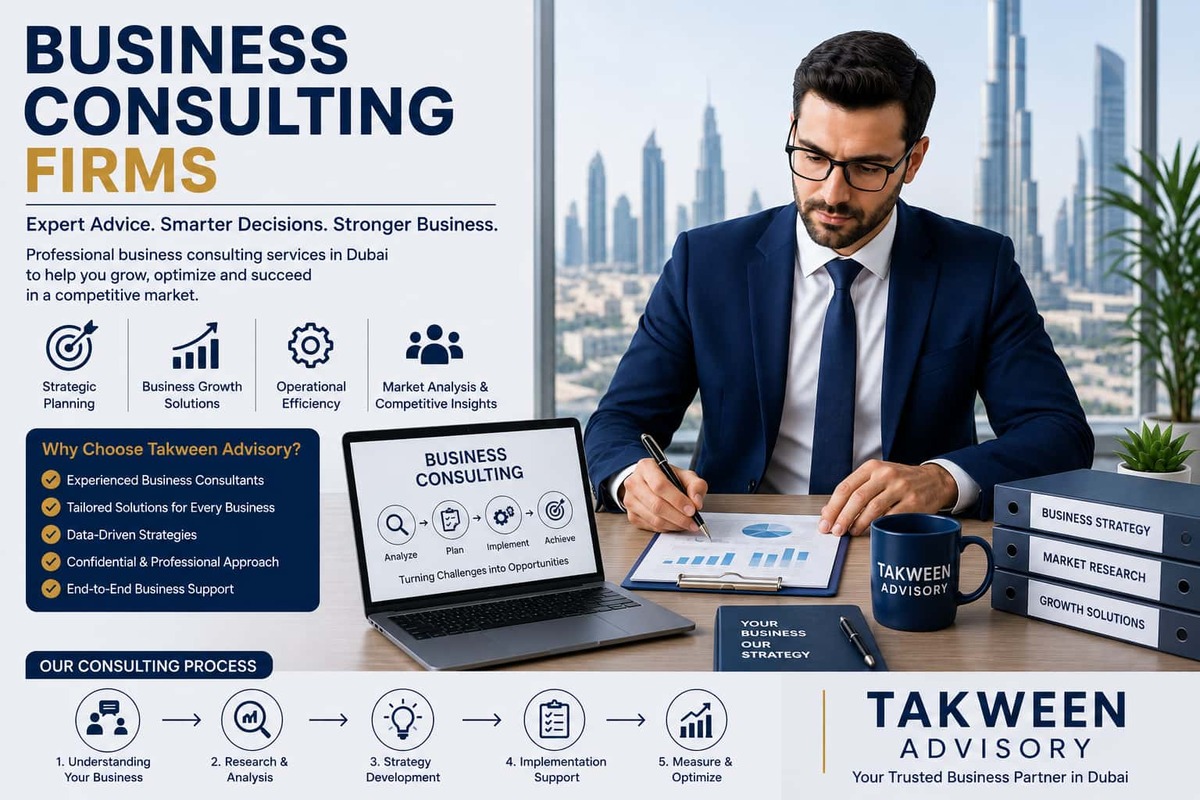
A Practical SME Scaling Framework
A structured growth programme can be organised into five stages.
Stage 1: Diagnose
Review the current business model, financial position, customers, employees, processes and technology.
Stage 2: Prioritise
Identify the highest-impact issues rather than attempting to change everything simultaneously.
Stage 3: Design
Create the strategy, operating processes, financial targets, organisational structure and implementation roadmap.
Stage 4: Implement
Assign responsibilities, introduce systems, train employees and establish reporting mechanisms.
Stage 5: Measure
Review KPIs regularly and adjust the strategy according to actual business performance.
This approach allows management to treat growth as a controlled process rather than an unpredictable expansion of workload.
How Takween Advisory Supports SME Growth in Dubai
Takween Advisory provides business advisory support for entrepreneurs and companies seeking to establish, improve and expand their operations in the UAE.
For an SME, advisory support can cover business planning, operational improvement, corporate structuring, financial and tax considerations, HR processes, compliance and expansion planning.
The focus should be on practical business decisions: identifying inefficiencies, establishing appropriate processes, improving management visibility and preparing the company for its next stage of growth.
With Dubai's SME ecosystem continuing to receive dedicated business-growth support and resources, companies can combine professional advisory expertise with available business networks and programmes to strengthen their growth plans.
Common Mistakes SMEs Make When Scaling
Scaling Revenue Without Scaling Operations
More customers can expose weaknesses in delivery, staffing and customer support.
Hiring Without a Workforce Plan
Rapid recruitment without defined responsibilities can increase costs without improving productivity.
Ignoring Cash Flow
Profitable sales do not guarantee sufficient cash to meet immediate obligations.
Delaying Compliance
Tax, licensing, accounting and regulatory requirements should be built into the operating model from the beginning.
Automating Poor Processes
Technology cannot solve an inefficient process if the underlying workflow has not been properly designed.
Keeping Every Decision with the Founder
Founder dependency can become a major bottleneck when the business reaches a larger scale.
SME Growth Checklist for UAE Businesses
Before implementing an expansion plan, management should review:
-
Business objectives and target markets
-
Revenue and profitability by business line
-
Cash-flow requirements
-
Operating processes
-
Organisational structure
-
Recruitment requirements
-
Technology systems
-
Customer acquisition and retention
-
Corporate tax and compliance
-
Licensing and regulatory requirements
-
Management KPIs
-
Expansion budget and timeline
A consultant can help turn this assessment into a practical implementation roadmap.
Conclusion
SME growth in Dubai requires more than generating additional sales. Sustainable scaling depends on the ability to manage higher customer volumes, control costs, develop employees, maintain financial visibility and comply with UAE business requirements.
Business consulting firms Dubai can support this process by bringing structured analysis and specialist expertise to strategy, operations, finance, people and technology.
For entrepreneurs, the most useful consulting approach is one that connects strategic objectives with practical implementation. A growth plan should explain not only where the company wants to go, but also how its people, processes, systems and finances will support that destination.
Takween Advisory can help UAE entrepreneurs assess their current operations, identify growth opportunities and develop practical strategies for building a more scalable business.
Frequently Asked Questions
1. What do SME business consulting firms in the UAE provide?
SME consultants can provide services covering business strategy, operational improvement, financial planning, HR, process optimisation, technology implementation, compliance and expansion planning.
2. Why do SMEs in Dubai need business consulting?
As an SME grows, operational complexity can increase. Professional consulting can help owners identify inefficiencies, improve processes, strengthen financial controls and create a structured expansion plan.
3. How can business consulting firms Dubai help with operational scaling?
They can review existing workflows, identify bottlenecks, establish standard operating procedures, improve organisational structures, introduce KPIs and recommend technology or outsourcing solutions.
4. When should an SME hire a business consultant?
An SME may consider consulting when it is experiencing rapid growth, entering a new market, hiring significantly, facing operational inefficiencies, preparing for expansion or dealing with increasingly complex financial and compliance requirements.
5. Can consultants help UAE SMEs with corporate tax planning?
Business consultants can help coordinate business planning and compliance requirements, while specialist tax professionals or approved tax agents should be used where regulated tax advice or filing services are required. The FTA provides current Corporate Tax registration and filing information through its official systems.
6. Is Small Business Relief available to UAE SMEs?
Eligible resident persons may elect for Small Business Relief where the applicable revenue threshold and other conditions are satisfied. The FTA currently specifies a revenue threshold of AED 3 million for the current and all previous relevant Tax Periods.
7. What should an SME measure when scaling?
Useful measures can include revenue growth, gross margin, operating expenses, cash flow, customer retention, receivables, employee productivity and profitability by product or service.
8. Can outsourcing help an SME scale?
Yes. Outsourcing selected specialist or administrative functions can allow an SME to access expertise without immediately creating a large internal department. The appropriate approach depends on the company's activities, compliance requirements and growth objectives.
9. How can Takween Advisory help SMEs in Dubai?
Takween Advisory can support SMEs with business advisory, strategic planning, operational improvement, corporate structuring, compliance coordination, financial considerations and expansion planning.
10. What is the first step in an SME growth strategy?
The first step is normally a structured assessment of the company's current financial position, operations, customers, people, systems and strategic objectives. This creates a factual foundation for deciding which improvements should be prioritised.